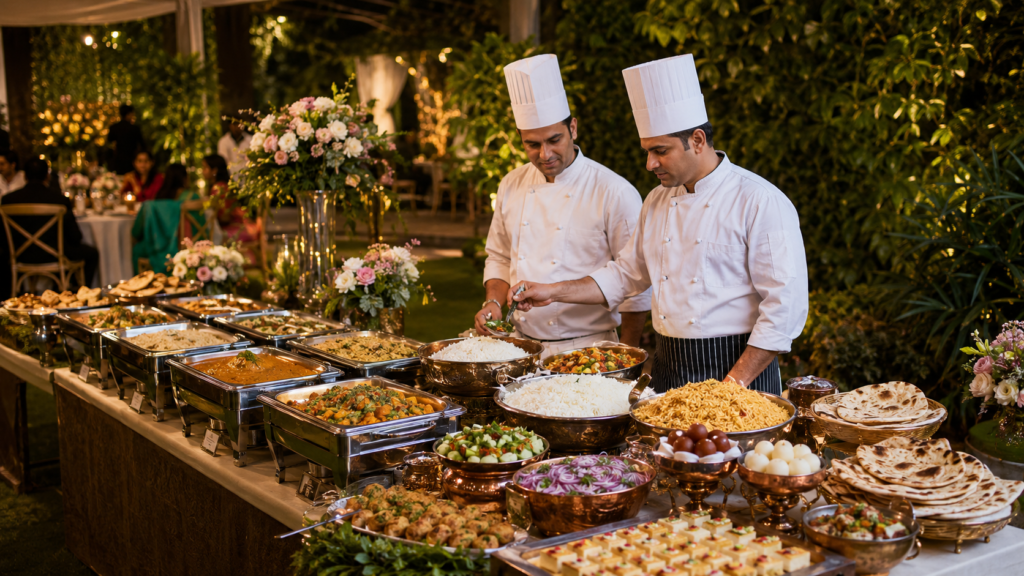
Planning food for 50 guests sounds simple, but small events often create more waste than large weddings. Hosts select too many dishes, calculate every item for all 50 people and add an oversized safety margin. The result is either an unbalanced buffet or costly leftovers. This guide gives practical starting quantities for an Indian birthday, engagement, anniversary, house function or intimate wedding.
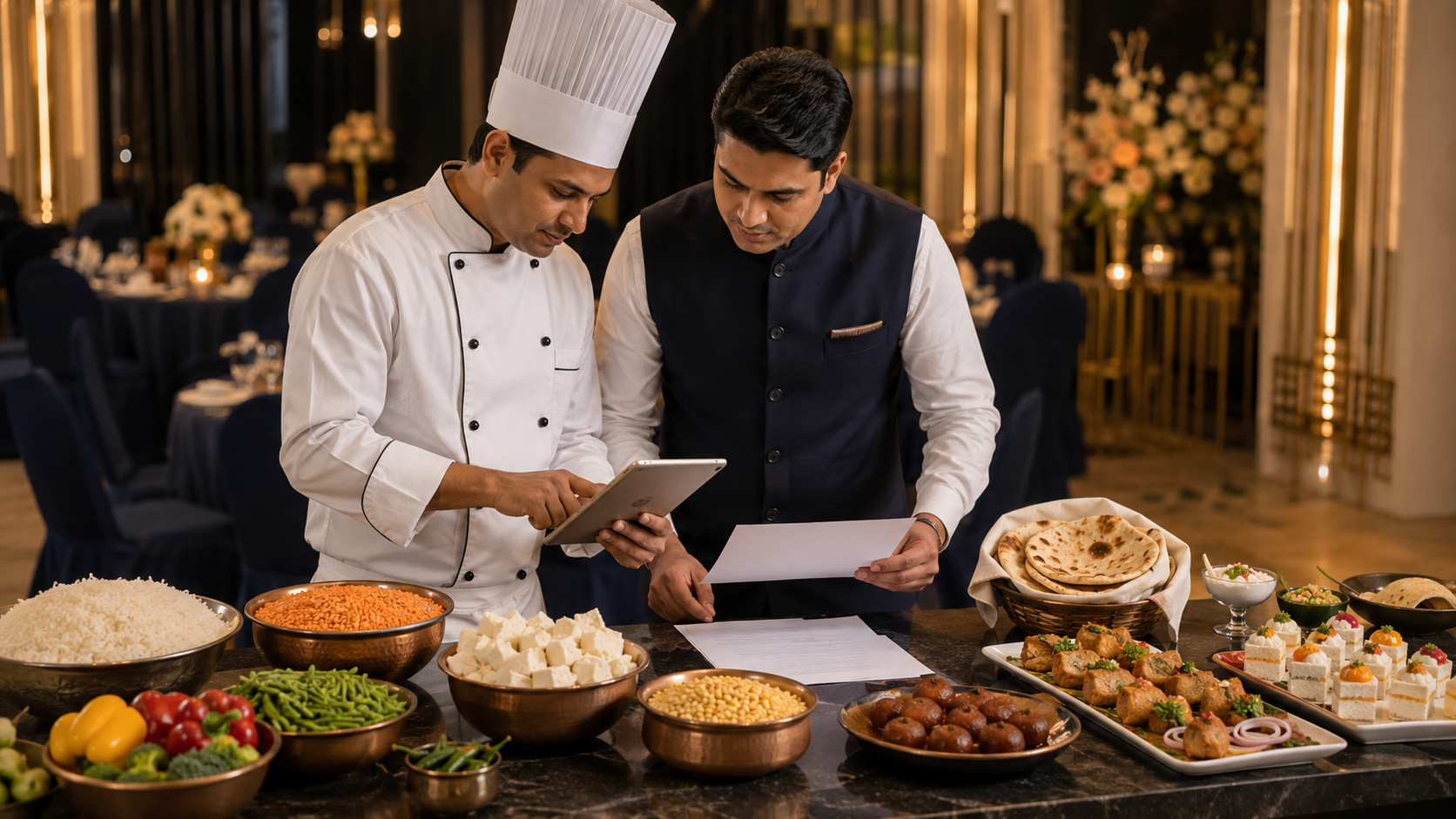
Calculate Adult-Equivalent Portions First
Do not begin by buying ingredients. First divide the guest list into adults and teenagers, children, toddlers, vendors and event staff. Adults and most teenagers can be counted as full portions. As a starting estimate, two children aged approximately 5–12 can equal one adult main-course portion, although children may consume full portions of popular starters and desserts.
Photographers, decorators, drivers and service partners should be listed separately. If they eat from the same buffet but are not included in the production count, even a correctly calculated menu may run short.
Food Quantity for 50 Guests: Master Table
These estimates assume a complete buffet containing starters, main course, rice, breads, accompaniments and dessert. A snacks-only party or biryani-led meal needs a different distribution.
| Food section | Starting quantity | When to adjust |
|---|---|---|
| Welcome drinks | 13–18 litres | Increase for summer, outdoor events or repeated service. |
| Starters | 300–400 pieces total | Use 450–500 when snacks replace part of dinner. |
| Raw rice | 4–5 kg | Suitable when breads and several curries are served. |
| Biryani-led raw rice | 6–7.5 kg | Use only when biryani is the main attraction. |
| Dry dal or pulses | 2.5–3.5 kg | Reduce when rajma, chole or several gravies are included. |
| Raw paneer | 4–5 kg total | Split this amount if paneer appears in more than one course. |
| Raw mixed vegetables | 6–8 kg total | Across one or two vegetable preparations. |
| Indian breads | 90–125 pieces | Size and rice availability affect consumption. |
| Raita | 5–6 litres | Reduce if curd-based chaat is also served. |
| Fresh salad | 4–5 kg | Replenish in small trays to avoid wilting. |
| Dessert | 55–60 portions | For two small sweets, plan roughly 90–110 pieces total. |
| Operational buffer | 5–10% | Add after attendance and staff meals are confirmed. |
These are planning ranges, not recipe guarantees. Actual yield changes with portion size, recipe, bone content, menu variety and service duration.
Vegetarian Food Quantity for 50 Guests
A good vegetarian menu does not need two paneer gravies, three dals and several similar fried starters. For a small event, every additional dish divides demand and makes accurate production harder. A balanced menu can include two welcome drinks, three starters, one paneer dish, one seasonal vegetable, one dal, one rice preparation, two bread options, raita, salad and two compact desserts.
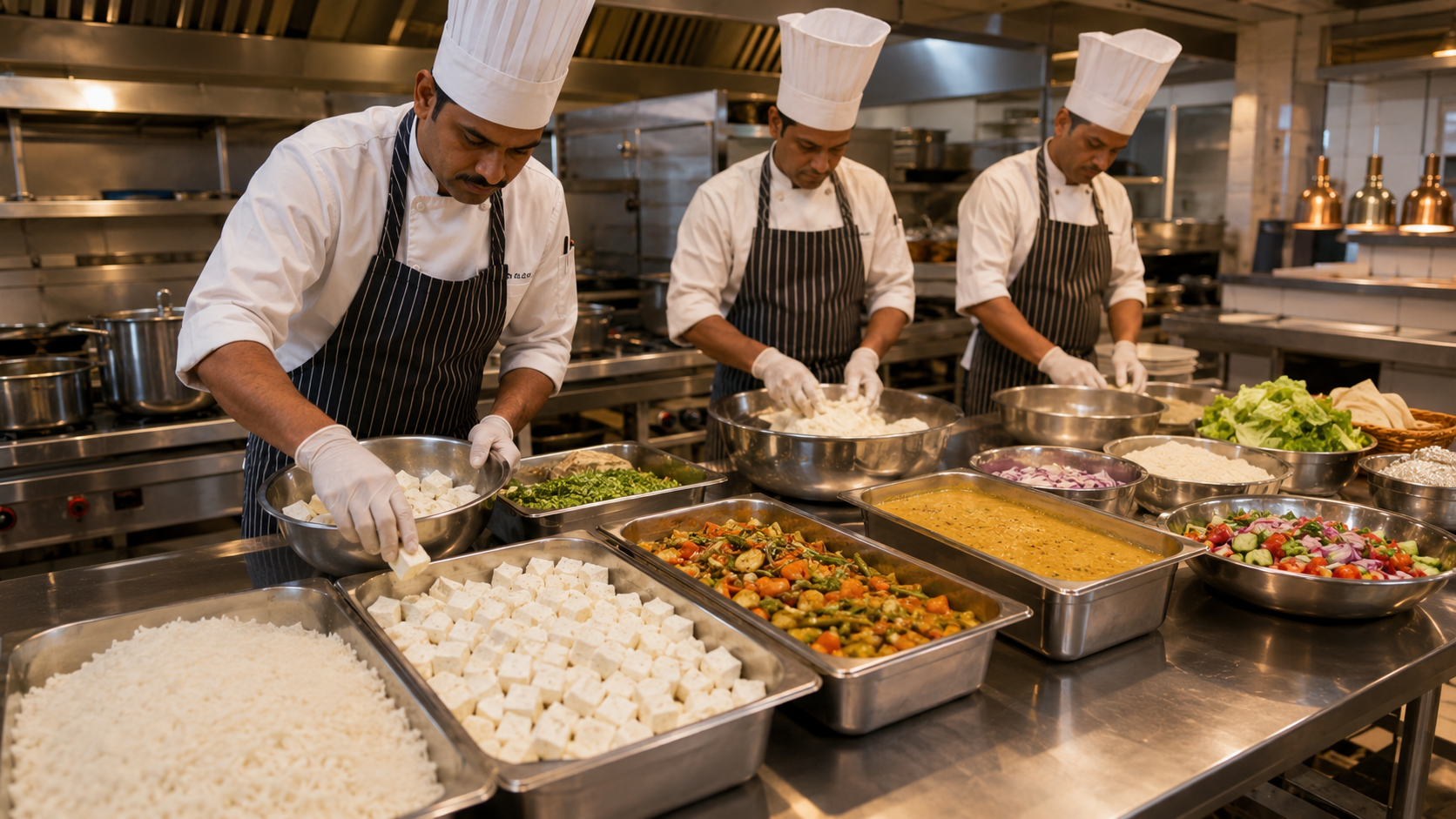
Sample Pure-Veg Quantity Plan
- Welcome drinks: approximately 15 litres divided between two choices
- Starters: 330–360 pieces across three varieties
- Paneer main course: 4–5 kg raw paneer
- Seasonal vegetable: 3–4 kg cleaned raw vegetables
- Dal: 2.5–3 kg dry pulses
- Rice: 4–5 kg raw basmati rice
- Breads: approximately 100–110 pieces
- Raita and salad: 5 litres raita and 4 kg salad
- Dessert: 55–60 full portions or two smaller sweets totalling around 100 pieces
Veg and Non-Veg Menu for 50 Guests
Calculate the actual food preference split instead of preparing non-vegetarian dishes for everyone. Suppose 30 guests prefer vegetarian food and 20 prefer non-vegetarian food. Shared rice, breads, raita, salad and desserts can be planned for the full count, while paneer and chicken quantities should follow their respective groups.
For approximately 20 non-vegetarian diners, 4–5 kg raw boneless chicken can be a reasonable starting range for one prominent chicken preparation. Bone-in curry requires a higher purchase weight. If both chicken starter and chicken curry are selected, divide the expected consumption across them instead of preparing both for all 20 diners independently.
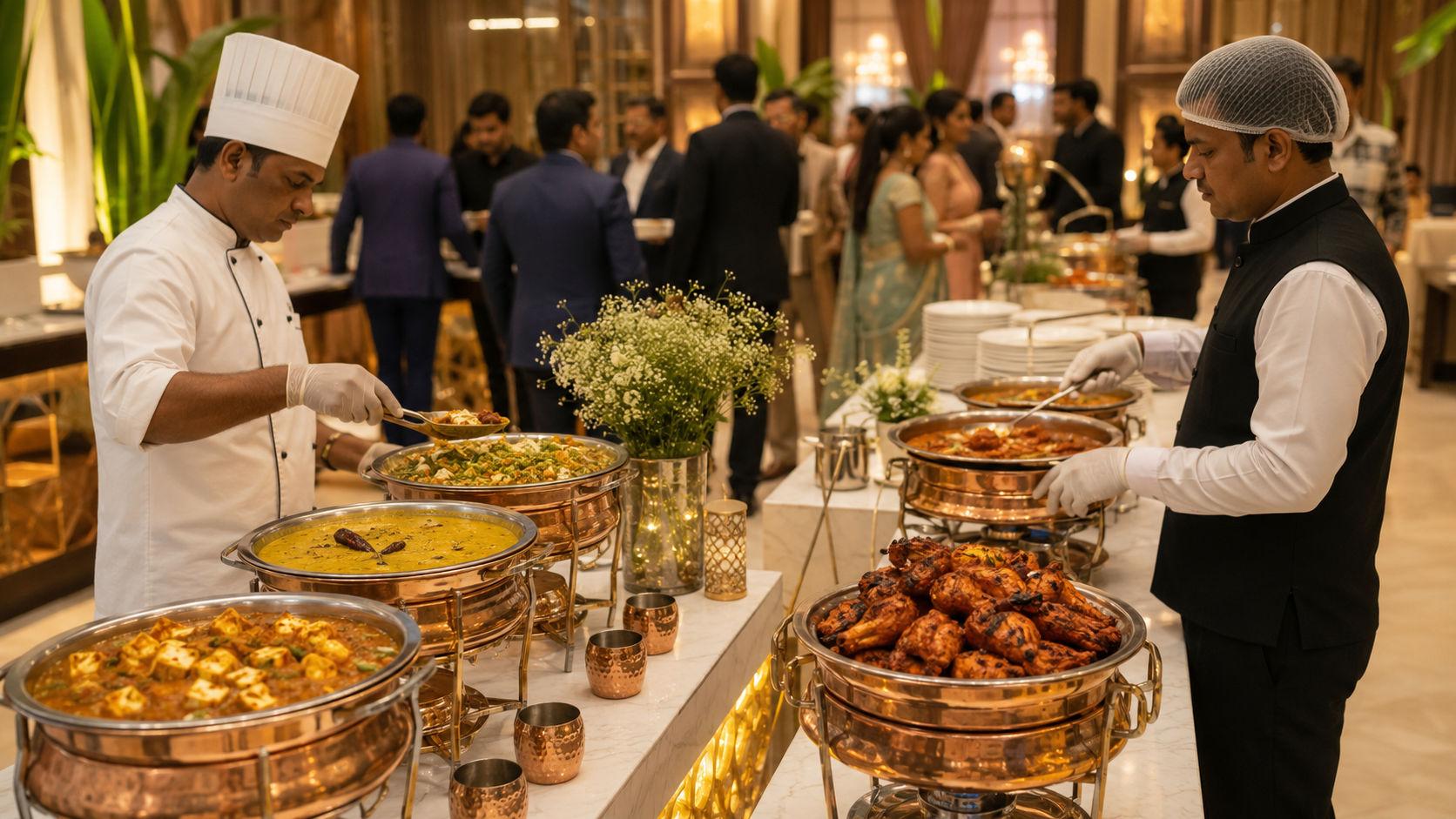
How Much Rice Is Needed for 50 People?
Use approximately 4–5 kg raw rice for a complete buffet that also includes breads, dal and multiple main dishes. If biryani is the principal meal with only a few accompaniments, approximately 6–7.5 kg raw rice may be more appropriate. Do not prepare pulao, biryani and plain rice at their maximum individual quantities; divide the total rice requirement between the chosen preparations.
How Much Dal and Paneer Is Needed?
For one dal in a multi-dish buffet, 2.5–3.5 kg dry pulses is a useful starting range. Use the lower end when rajma, chole or multiple gravies are present. For one popular paneer main course, begin around 4–5 kg raw paneer. If paneer tikka is also a starter, the chef should calculate the combined paneer purchase rather than treating both dishes independently.
How Many Rotis or Naans for 50 Guests?
Plan approximately 90–125 pieces when rice is also served. Bread size matters: a large naan is not equivalent to a small tandoori roti. Use a live tandoor or replenish small batches so guests receive fresh bread and the entire quantity is not exposed before the main dinner rush.
Quantity Changes by Event Type
Birthday party
Children may eat fewer main-course portions but more familiar snacks, fries, pasta and desserts. Use the age mix, not only total attendance.
Engagement or roka
A focused premium buffet normally performs better than too many similar dishes. Include staff meals in the final count.
House function
Limited kitchen and buffet space makes controlled batches important. Choose dishes that can be held and served safely.
Intimate wedding
A longer event schedule can increase drinks and starters. Live counters should complement, not duplicate, the main buffet.
Buffet Service for a 50-Person Event
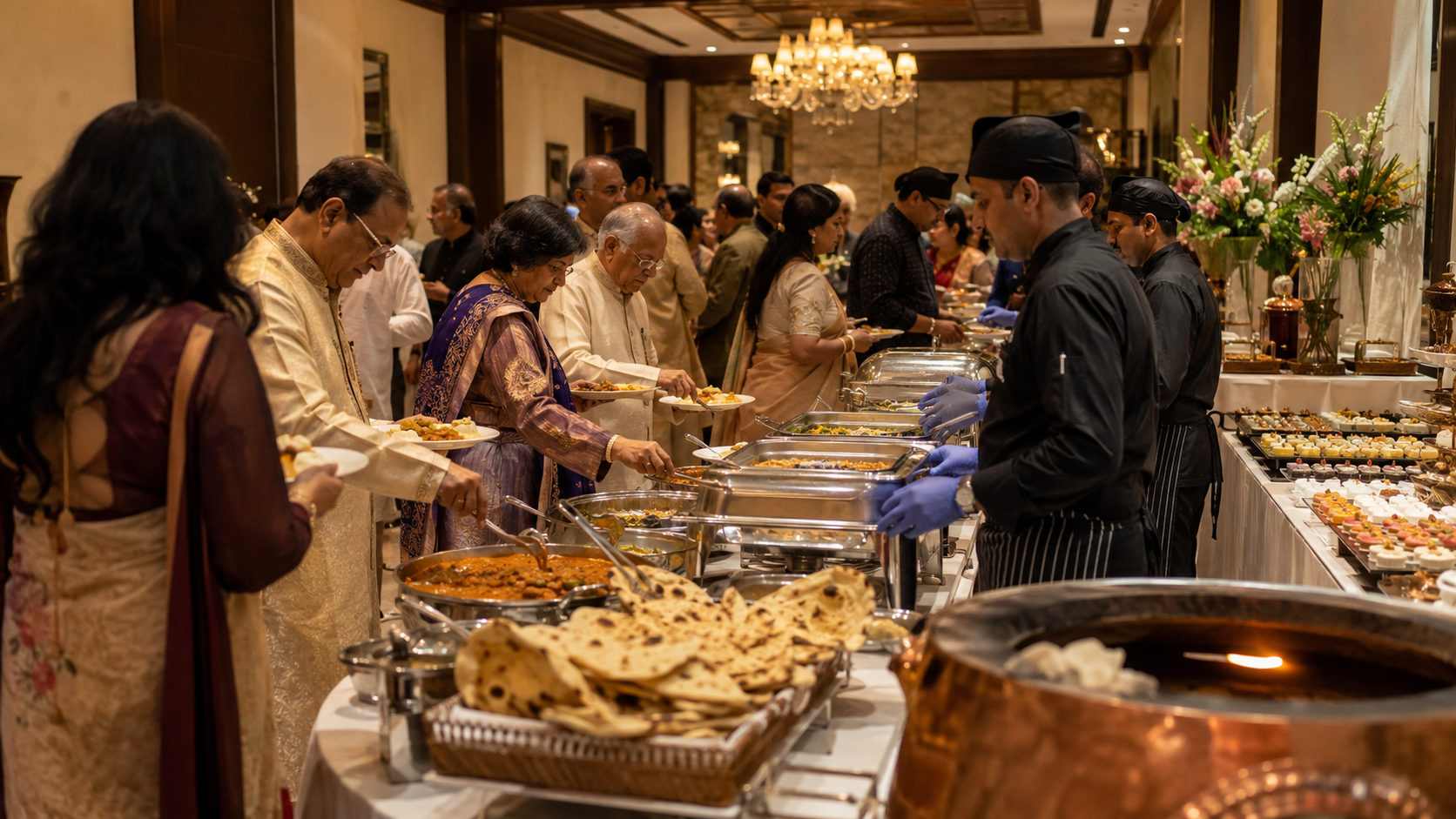
A compact event rarely needs a very long buffet. One logical service line, a separate beverage point and a small dessert station are usually easier for guests. Keep plates at the start, place rice and breads close to the gravies, and use appropriate serving spoons to control the first rush.
Replenishment Plan
- Display only part of each dish at opening time.
- Keep a hot reserve in controlled kitchen containers.
- Assign one team member to monitor the popular starter, paneer, rice and dessert.
- Refill before a tray becomes empty, but avoid opening every reserve batch simultaneously.
- Prepare breads fresh according to actual demand.
Common Mistakes That Cause Waste or Shortage
- Calculating every starter variety for all 50 guests
- Preparing full quantities of both rice and biryani
- Ignoring children, vendors and service partners
- Adding a large buffer independently to every course
- Choosing too many dishes for a compact guest list
- Using oversized serving spoons during the opening rush
- Preparing all naan or roti before guests begin dinner
How to Finalise Your Catering Requirement
- Freeze the realistic RSVP count 48–72 hours before the event.
- Confirm adults, children, vegetarian and non-vegetarian guests.
- Add vendor and staff meals separately.
- Choose the menu before calculating individual ingredients.
- Discuss cooked yield and serving size with the chef.
- Add only a controlled 5–10% operational buffer.
- Approve a written production and replenishment plan.
Planning a larger celebration? Compare this calculation with our food quantity for 100 guests and food quantity for 200 guests guides. For service and menu help, explore catering services in Dehradun.
Frequently Asked Questions
How much food is enough for 50 guests?
For a full Indian buffet, start around 300–400 starter pieces, 4–5 kg raw rice, 2.5–3.5 kg dry dal, 90–125 breads and 55–60 dessert portions. Adjust for children, event duration and menu variety.
How much rice is needed for 50 people?
Approximately 4–5 kg raw rice is generally suitable when breads and several curries are also served. A biryani-led meal may require around 6–7.5 kg raw rice.
How much paneer is required for 50 guests?
For one main paneer dish, approximately 4–5 kg raw paneer is a practical starting range. Divide the amount if paneer is also served as a starter.
How many starter pieces are required for 50 guests?
Plan approximately 300–400 pieces across all varieties for a full-meal event. Increase the total when starters are served for a long period or replace part of the main meal.
How many rotis or naans should be prepared?
Approximately 90–125 breads can work when rice is also available. Adjust for bread size and prepare them in fresh batches.
How much dessert is needed for 50 guests?
Plan 55–60 full dessert portions. If serving two small Indian sweets, approximately 90–110 small pieces in total is a useful starting estimate.
How much extra food should be kept?
Add a controlled 5–10% after confirming attendance and staff meals. Adding a large buffer to every individual dish creates excessive leftovers.
Should children be counted as full portions?
For main-course planning, two children aged approximately 5–12 may be counted as one adult portion initially. Popular snacks and desserts should be considered separately because children may take full servings.